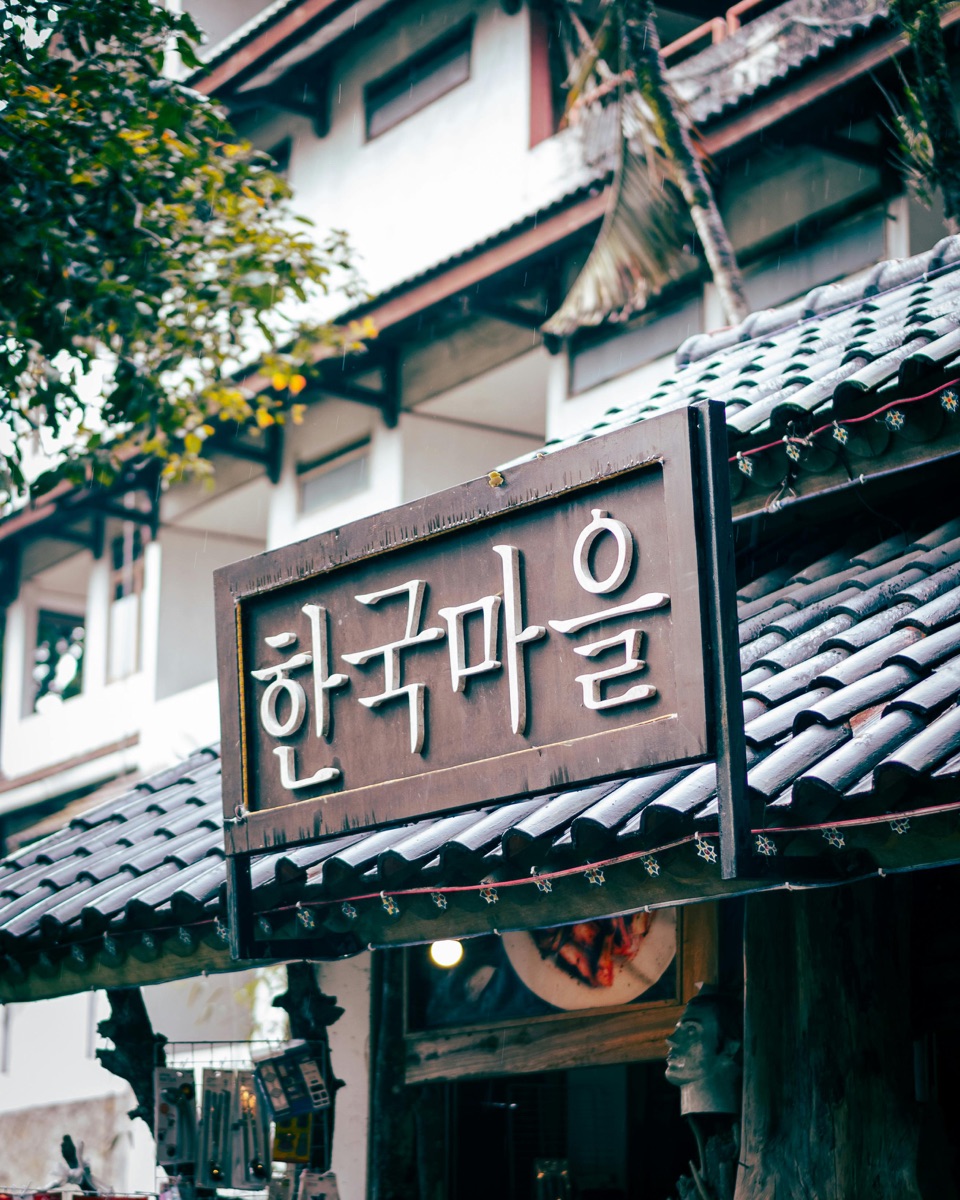
Here’s a question that separates beginners from fluent readers: when you see 한, do you see three letters — ㅎ, ㅏ, ㄴ — or do you see one thing?
Korean isn’t written in a row of letters like English. It’s written in syllable blocks (음절, eumjeol): squares that pack 2–4 letters into a single visual unit, one block per spoken syllable. Understanding how these blocks are built — and training your eyes to read them as wholes — is the entire game of Korean reading fluency.
The Building Blocks: 3 Slots
Every Korean syllable block has up to three slots:
- Initial consonant (초성) — always present. If the syllable starts with a vowel sound, the silent placeholder ㅇ fills the slot.
- Vowel (중성) — always present.
- Final consonant(s) (종성) — optional. This is the famous batchim.
So the smallest block is consonant + vowel (가), and the fullest is consonant + vowel + double batchim (닭).
The 4 Block Patterns
The vowel’s shape decides the layout. That’s the whole rule.
Pattern 1: Vertical vowel → side by side
Vowels drawn tall (ㅏ, ㅑ, ㅓ, ㅕ, ㅣ, ㅐ, ㅔ) sit to the right of the initial consonant:
| Block | Letters | Sound |
|---|---|---|
| 가 | ㄱ + ㅏ | ga |
| 니 | ㄴ + ㅣ | ni |
| 재 | ㅈ + ㅐ | jae |
Pattern 2: Horizontal vowel → stacked
Vowels drawn wide (ㅗ, ㅛ, ㅜ, ㅠ, ㅡ) sit below the initial consonant:
| Block | Letters | Sound |
|---|---|---|
| 고 | ㄱ + ㅗ | go |
| 무 | ㅁ + ㅜ | mu |
| 스 | ㅅ + ㅡ | seu |
Pattern 3: Vertical vowel + batchim
Add a final consonant across the bottom:
| Block | Letters | Sound |
|---|---|---|
| 한 | ㅎ + ㅏ + ㄴ | han |
| 밥 | ㅂ + ㅏ + ㅂ | bap |
| 김 | ㄱ + ㅣ + ㅁ | gim |
Pattern 4: Horizontal vowel + batchim
Three levels stacked:
| Block | Letters | Sound |
|---|---|---|
| 굴 | ㄱ + ㅜ + ㄹ | gul |
| 곰 | ㄱ + ㅗ + ㅁ | gom |
| 흙 | ㅎ + ㅡ + ㄺ | heuk |
That last one has a double batchim (ㄺ) — two consonants sharing the final slot. Only 11 double-batchim combinations exist, and pronunciation rules decide which of the two consonants you actually hear.
Compound Vowels: The Corner Case
Some vowels combine a horizontal and vertical stroke (ㅘ, ㅝ, ㅚ, ㅟ, ㅢ…). These wrap around the consonant — below and beside it:
| Block | Letters | Sound |
|---|---|---|
| 과 | ㄱ + ㅘ | gwa |
| 원 | ㅇ + ㅝ + ㄴ | won |
| 의 | ㅇ + ㅢ | ui |
Why Blocks Beat Letters (The Fluency Secret)
Korean has ~11,172 theoretically possible blocks, but only about 2,000 appear in real text, and roughly 300 blocks cover the bulk of everything you’ll ever read. That’s the magic number.
Fluent readers don’t parse ㅎ+ㅏ+ㄴ; they recognize 한 instantly, the way you recognize “the” without spelling it out. Psychologists call this chunking — and it’s trainable:
- Beginner: reads letter-by-letter, ~30–50 characters per minute
- After block training: reads block-by-block, 100–150+ CPM
- Native: reads word-by-word, 250+ CPM
The jump from letters to blocks is exactly what our reading practice exercises target — and what the Batchim app’s syllable sprints automate with rapid-fire drills.
Blocks + Sound Changes = Real Korean
One warning: blocks tell you the spelling, and spelling isn’t always pronunciation. When blocks touch, batchim consonants interact with the next block — 한국말 is pronounced [한궁말], 학교 is [학꾜].
These interactions follow six predictable patterns. Once you read blocks confidently, the Korean pronunciation rules guide is your next step.
Practice: Read These Block-by-Block
Cover the romanization and read each word out loud. Feel yourself grabbing whole blocks:
| Word | Blocks | Meaning |
|---|---|---|
| 한국 | 한 + 국 | Korea |
| 사랑 | 사 + 랑 | love |
| 서울 | 서 + 울 | Seoul |
| 김치 | 김 + 치 | kimchi |
| 빨리빨리 | 빨 + 리 ×2 | hurry hurry |
New to Hangul entirely? Start with the complete Hangul guide for the alphabet basics, then come back here. And when you’re ready to make block recognition automatic, Batchim’s syllable sprint drills train exactly this — 15 minutes a day until blocks read themselves.